If you run an agency or manage marketing operations, you know the invisible problem: repetitive browser work that never quite gets automated. Updating product descriptions across five markets. Publishing content to three different CMS platforms. Changing prices on an e-commerce backend before a campaign goes live. And then the spike hits: a product launch, a seasonal push, a last-minute brief. The same tasks that were already slow suddenly need to happen at three times the volume, with the same team, in half the time. These tasks are too manual to ignore, too bespoke for off-the-shelf tools to handle, and too unpredictable to staff for.
AI agents promise to solve this. In practice, they bring a new set of problems: unpredictable clicks, privacy concerns, and costs that spiral fast. We built something different.
Show it once. Run it at scale.
Learning by Demonstration (LBD) is Lorenz's proprietary core technology. The idea is simple: instead of configuring an automation with code or complex rules, you do the task yourself, once, and the platform turns that recording into a repeatable workflow.
You paste a URL into Lorenz. A browser emulator opens. You complete the task exactly as you would normally: navigating the CMS, filling in the fields, publishing the content. When you're done, that session becomes an automation. From that point on, you can trigger it in plain language, attach a CSV with updated parameters, schedule it, or run it in parallel across dozens of URLs at once. Automations can be shared across team members, making handovers on operational roles as simple as passing a link.
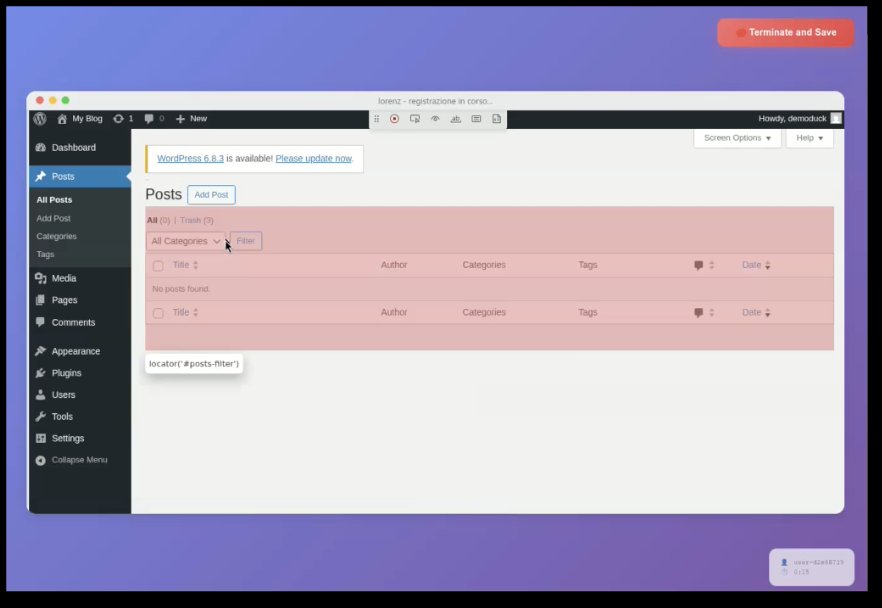
Step 1: User does the task, the system creates the automation
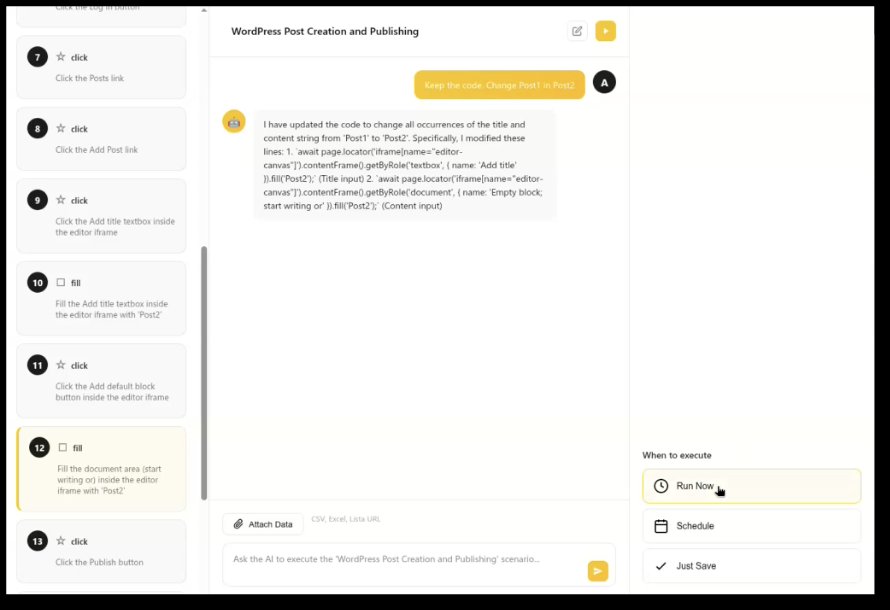
Step 2: User configures and launches the activity via chat
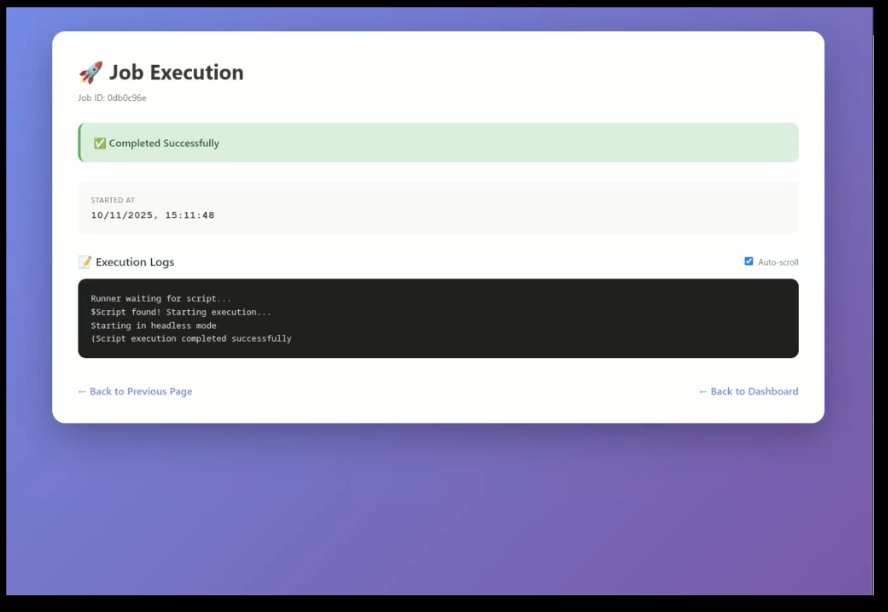
Step 3: User launches it at scale
Lorenz uses AI where it adds value: understanding your brief, reading a CSV, letting you trigger workflows in natural language. The execution runs on Playwright, a battle-tested browser automation layer, on a lightweight cloud server. The result is the reliability of classical automation with the flexibility of AI.
What you can actually do with it
Multi-market publishing: Record once on a single CMS instance. Run the same workflow across every brand, language, and market in a single batch.
Bulk updates via CSV: Attach a CSV with new values. Lorenz maps each row to the right field and runs the update across every record automatically.
Scheduled execution: Schedule any workflow to run on a recurring basis: weekly reports, pre-campaign setup, regular content pushes, all without manual intervention.
Team handover: Package automations and share them across team members or external agencies. They run the workflow without touching the underlying system.
Why not just use an AI agent?
Browser-based AI agents, tools that use vision models to navigate interfaces on their own, are impressive technology. For high-volume, production work in an agency context, they have three real limitations.
Reliability. An AI agent deciding where to click on a page makes a probabilistic inference on every step. Most of the time it's right. When you're running 500 product updates, most of the time is not good enough. LBD records exact interactions: the same path, every time.
Privacy. Many enterprise clients, including their IT departments, are not comfortable with an AI model reading their CMS, ERP, or e-commerce backend. With LBD, the AI only processes the brief and the parameters. The automation itself runs as a deterministic script.
Cost. This one matters most at scale. To put it in concrete terms: running 1,000 workflow executions with Lorenz costs roughly 1/100 of what you would pay using a pure AI agent like Claude or GPT-4. The difference comes from where the AI is actually used: only for the brief and parameter mapping, not for every click and field interaction.
~$0.0001
Cost per execution with Lorenz LBD
~$0.15-0.50
Cost per execution with a full AI agent
up to 100x
Cost difference at scale
The access model agencies actually need
There is one more dimension that matters for agencies: access control. With LBD, an IT department can package a set of automations and hand them to an external agency. The agency runs the workflows: updating content, changing prices, publishing assets, without ever touching the underlying system directly. No shared CMS credentials. No training on proprietary platforms. No exposure.
The client keeps control. The agency moves faster. The work gets done with a fraction of the operational overhead.